The Guide to Delta Air Lines Fare Classes
Delta breaks down its service tiers into fare classes. Each comes with different allowances and restrictions.

Many or all of the products on this page are from partners who compensate us when you click to or take an action on their website, but this does not influence our evaluations or ratings. Our opinions are our own.
Updated · 6 min read

Written by
Contributing Writer 
Edited by
Assigning Editor We’ve all seen it. We look for a plane ticket online and find different prices, even between the same cities on the same day. Changing the date can also make a huge fare difference.
It’s called dynamic pricing, and all the airlines do it, including Delta Air Lines. It means various factors like demand and competition help to determine the fares, and it has been in place for decades.
Delta has several fare types, ranging from basic economy to a first class experience, and even more subcategories within those types. Each one has a letter associated with it, serving as an identifier.
Here’s a look at Delta’s fare structure to help you understand why these letters matter.
Get the 'Cheat Codes' to Cheaper Travel
Unlocking the secret to saving a ton on travel is easier than you think. 📤 Our free newsletter shows you how in 5 min. or less.
What are fare classes, and why do they matter?
Airlines, including Delta, offer fare classes, meaning there are different ticket types within the same cabin. Sometimes this is called a fare bucket or a fare basis code (FBC) or fare basis.
The FBC is an identifying factor that can quickly tell a travel agent or airline employee the type of ticket someone has. At a glance, someone can know your cabin class, whether your ticket is refundable, whether it is eligible for upgrades and more.
The FBC is usually a letter in parentheses after the cabin name, and it can be different for each part of a ticket.

For example, this round-trip ticket in Delta’s main cabin has a fare code of T on the outbound flight and X on the return.
Delta fare class overview
Don’t confuse FBCs with what Delta calls experiences.
Let’s start with those.
On nonrefundable tickets, there are two main fare types: Basic and Classic.
Basic fares:
- Delta Main Basic (basic economy).
- Delta Comfort Basic.
Classic fares:
- Delta Main Classic.
- Delta Comfort Classic.
- Delta Premium Select Classic.
- Delta First Classic.
- Delta One Classic.
As for refundable fares, you will see:
- Delta Main Extra.
- Delta Comfort Extra.
- Delta Premium Select Extra.
- Delta First Extra.
- Delta One Extra.
There are few things that differentiate the fare classes besides cost.
- Delta One: It’s the premium experience with lie-flat seats, chef-curated meals, sommelier-selected wines and more. Two checked bags are also free.
- Delta Premium Select: This fare and cabin class is mostly available on long-haul international flights. Premium Select has upgraded seats with leg rests, two free checked bags, early boarding and more.
- Delta First: This experience is mostly on domestic flights and includes wider seats, Sky Priority benefits, two free checked bags and more.
- Delta Comfort: People in Delta Comfort have more legroom, dedicated overhead space and included alcoholic beverages. The seats are the same as they are in the main cabin.
- Delta Main: This is the main cabin on Delta planes. Delta Main Basic passengers also sit in the main cabin but cannot select seats in advance, cannot change their tickets and board last.
Then there are the codes, which further break down the fares into those fare buckets.
These are some examples of the fare codes Delta often uses:
- First class: F.
- Delta One: D.
- Delta Premium Select: P, Q, U, A, G.
- Delta Comfort: C, I, 1, 2, W, S.
- Delta Main: M.
- Delta Main Basic: B, L.
But you will see other letters that show further breakdowns of the fares, like if they’re discounted, full fare or even if they are part of a travel package like a cruise or a group.
That might be why the flight example above has a T and an X. This alphabet soup is mostly behind-the-scenes and helps Delta employees know what type of fare you have.
Some of these codes go along with Delta’s fare structure and differentiate between amenities and rules regarding the fares and only come up when specific inventory is available to book.
» Learn more: The best airline credit cards right now
Finding the Delta Air Lines fare code
So, how do you find that fare class? You can find it when you book a ticket but not until you get to the pricing page.
Looking at a booking from Tampa to Atlanta, you can see the first two flights have different fares for three main types: Delta Main, Delta Comfort and Delta First.
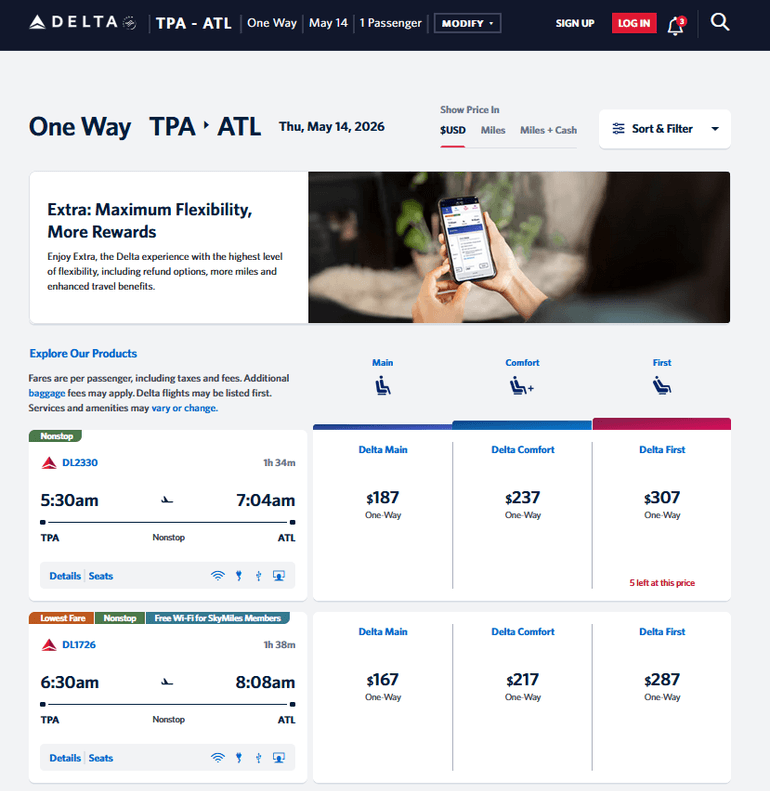
Going deeper, if you select Delta Main, additional options come up for Main Basic, Main Classic and Main Extra. Each has a different cost, which means each has a different fare code.
Let’s look at the 5:30 a.m. flight first.

The same thing happens when Delta Comfort and Delta First are selected.
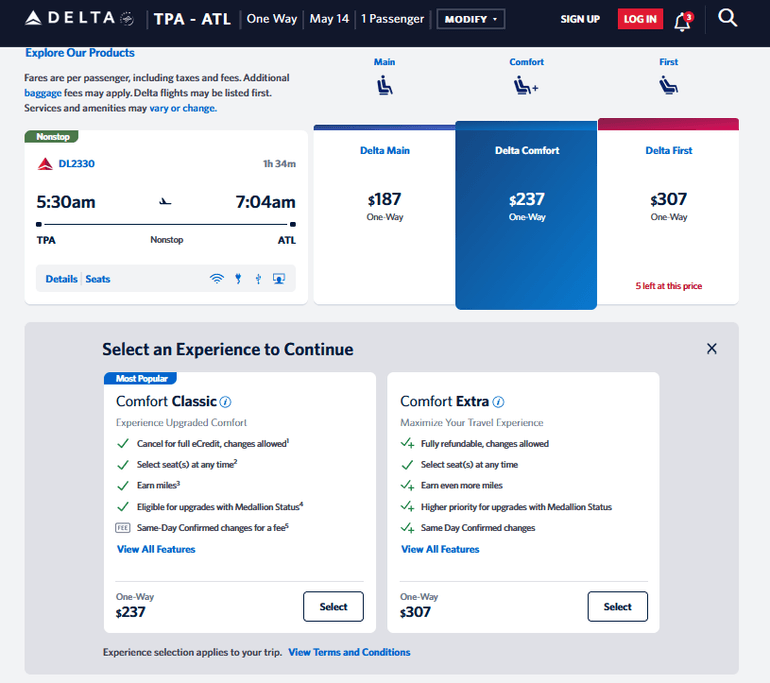
That means there are several different fare codes on this one flight.
Going back to the Delta Main selection, if you accept the restrictions and choose that fare, the trip summary shows the ticket is in Main Basic (E).

Selecting Main Classic puts it in Main Classic (T); selecting Delta Comfort Classic puts the fare in S; and selecting First Classic puts the ticket in Z.
Knowing whether you purchased an Extra fare that is refundable does not show up on the booking screen, but will be coded behind the scenes. The Main Extra seat has a T code, the same as the above Main Classic example.
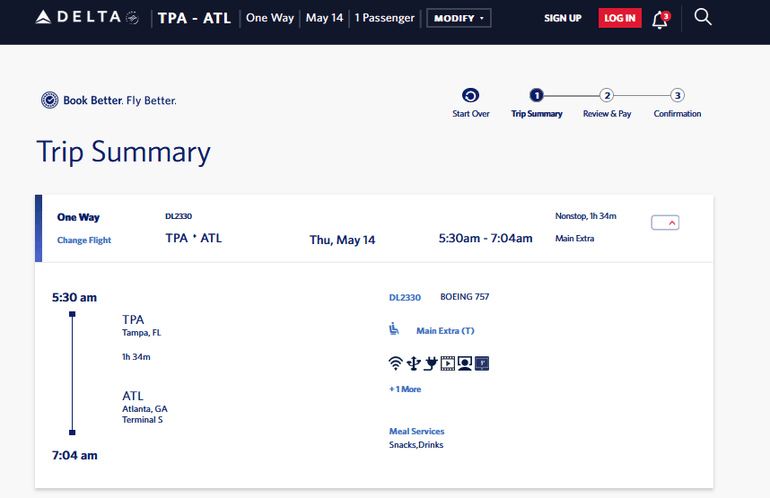
For the 6:30 a.m. flight, you’ll see the fare prices are different, meaning the codes might be different. Main Classic on this flight is X.

Comfort Classic is S, and First Classic is Z, the same as the other flight.
To understand what those letters mean, click on the name and letter from the booking page, and a screen will pop up explaining the fare.

Why is the fare class important?
Knowing the fare code isn’t too important in many cases, but it can be crucial when changing a flight.
If you are booked in Delta Main or Delta Comfort and try to change a flight — either by calling Delta customer service or going online — to another flight on the same day as your original flight, the same fare class needs to be available to make the change.
Delta Basic fares are not changeable.
The fare class policy does not apply to tickets in Delta One, Delta First and Delta Premium Select. Only availability in the same cabin class applies, so if another seat is available in the cabin, it might be yours to book.
The fare class and cabin can also affect the free upgrades available to Medallion members. Passengers who buy Extra fares have a higher priority over those with Classic fares. Tickets with Basic fares are not eligible for upgrades.
SkyMiles earnings by fare class
The fare class and the experience that goes with it matter a bit when earning Delta SkyMiles.
SkyMiles members earn 5 miles per $1 spent on a Classic or refundable ticket. It’s 2 miles for every $1 in Comfort Basic. Main Basic tickets do not earn SkyMiles.
On Delta-operated flights, it’s the base fare and carrier-imposed surcharges that count toward earning SkyMiles.
Medallion members earn more, but they also do not earn miles in Delta Main Basic.
SkyMiles earning rates for Medallion members, regardless of fare class:
- Silver Medallion: 7 SkyMiles per $1 spent.
- Gold Medallion: 8 SkyMiles per $1 spent.
- Platinum Medallion: 9 SkyMiles per $1 spent.
- Diamond Medallion: 11 SkyMiles per $1 spent.
Earning Delta SkyMiles by flying on SkyTeam partner airlines
While the fare class might not mean a whole lot if you’re flying on a Delta flight, it matters a bunch when flying with one of Delta’s SkyTeam partners.
For example, when flying Korean Air, redeemable miles are based on a percentage of the distance flown and vary based on the fare class. Distance flown is based on the calculated distance between the flight’s origin and destination.
A passenger flying in Korean Air business class will earn 200% of the miles flown, while someone in economy will earn only 100%.
Medallion Qualification Dollars are also based on the distance flown and fare class and are at least 500 per flight, and some flights are excluded. This is on Korean Airlines, and each partner is different.
On Vietnam Airlines, only business class, premium economy and full-priced economy tickets earn 100% miles. Some discounted economy tickets earn only 10% of the miles flown. Tickets on Vietnam Airlines earn only 250 MQDs.
🤓 Nerdy Tip
If maximizing mileage and status is important to you, you might want to check earning rates on partner airlines when deciding how to fly to some destinations. For example, it might be worth calculating miles and MQDs before deciding whether to take a Delta plane or an Air France one on a flight from New York to Paris. The earning rates might be different. Delta credit cards
The credit card you use to book your Delta flight might be able to upgrade your travel experience.
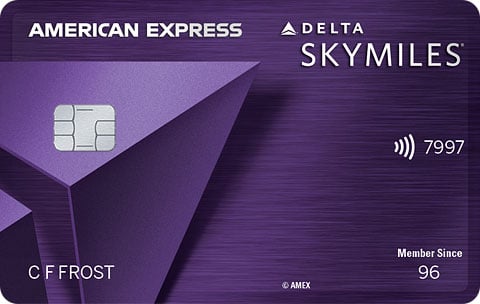
For example, the American Express Platinum Card® and the Delta SkyMiles® Reserve American Express Card include a number of Delta Sky Club access passes so you can relax and enjoy the club before your flight or between connections. Terms apply.
Other cards will help you earn SkyMiles you can use to cover your flight or upgrade your tickets.
Top Delta cards
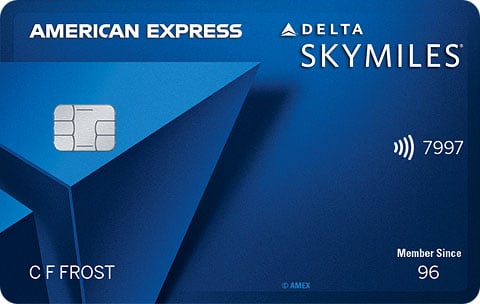
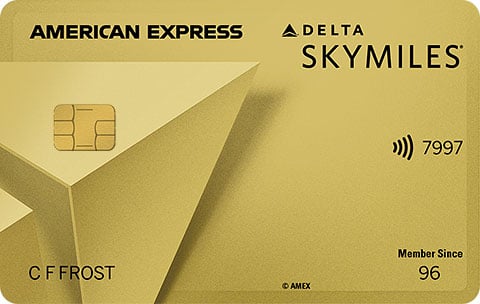
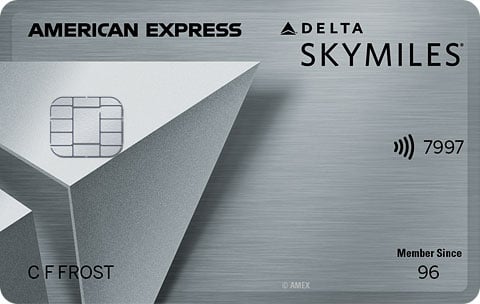
Annual fee
$0.
$0 intro for the first year, then $150.
$350.
$650.
Welcome offer
Earn 10,000 bonus miles after you spend $1,000 in purchases on your new Card in your first 6 months. Terms Apply.
Earn 70,000 Bonus Miles after you spend $3,000 in purchases with your new Card, and an additional 20,000 bonus miles after you make an additional $2,000 in purchases on the Card, both within your first 6 months. Ends 04/01/2026. Terms Apply.
Earn 80,000 Bonus Miles after you spend $4,000 in purchases with your new Card, and an additional 20,000 bonus miles after you make an additional $2,000 in purchases on the Card, both within your first 6 months. Ends 04/01/2026. Terms Apply.
Earn 100,000 Bonus Miles after you spend $6,000 in purchases with your new Card, and an additional 25,000 bonus miles after you make an additional $3,000 in purchases on the Card, both within your first 6 months. Ends 04/01/2026. Terms Apply.
Learn more
» Learn more: Is a Delta card worth it?
Delta fare classes recapped
Delta has several flying experiences, such as Delta One, Delta Premium Select, Delta Comfort and Delta Main, and within those there are many different fare codes that determine the overall cost of the flight, what the fare includes and even how many SkyMiles you earn.
You can find the fare code when you book the flight so there are no surprises later.
(Top photo courtesy of Delta Air Lines)
To view rates and fees of the Delta SkyMiles® Blue American Express Card, see this page.
To view rates and fees of the Delta SkyMiles® Gold American Express Card, see this page.
To view rates and fees of the Delta SkyMiles® Platinum American Express Card, see this page.
To view rates and fees of the Delta SkyMiles® Reserve American Express Card, see this page.
How to maximize your rewards
You want a travel credit card that prioritizes what’s important to you. Here are some of the best travel credit cards of 2026:
- Flexibility, point transfers and a large bonus: Chase Sapphire Preferred® Card
- No annual fee: Wells Fargo Autograph® Card
- Flat-rate travel rewards: Capital One Venture Rewards Credit Card
- Bonus travel rewards and high-end perks: Chase Sapphire Reserve®
- Luxury perks: American Express Platinum Card®
- Business travelers: Ink Business Preferred® Credit Card
Article sources
NerdWallet writers are subject matter authorities who use primary,
trustworthy sources to inform their work, including peer-reviewed
studies, government websites, academic research and interviews with
industry experts. All content is fact-checked for accuracy, timeliness
and relevance. You can learn more about NerdWallet's high
standards for journalism by reading our
editorial guidelines.
Limited Time Only: Earn $1,000 Toward Travel!
Capital One Venture Rewards Credit Card 
Travel
For a limited time, the
Capital One Venture Rewards Credit Card is offering new cardholders an especially rich bonus: Enjoy $250 to use on Capital One Travel in your first cardholder year, plus earn 75,000 bonus miles once you spend $4,000 on purchases within the first 3 months from account opening - that’s equal to $1,000 in travel!