







This article originally appeared in NerdWallet's investing newsletter, the Nerdy Investor. You can subscribe for free here.
Anthropic, the maker of the Claude chatbot, is the largest pure-play AI lab in the world, and it just completed the largest IPO ever. On Nov. 19, it raised more than $81 billion at a valuation of $1.5 trillion.
Americans are divided in their opinions about big AI IPOs like this. In an October survey by NerdWallet and The Harris Poll, 39% of respondents said that they were likely to buy shares in a major AI IPO, while 42% said that they were not. Men were more interested than women, and younger Americans were more interested than older generations.
Below, we're breaking down what we know about Anthropic's recent IPO and the company's financial situation. We're also discussing how to invest in Anthropic, both directly and indirectly (click here to jump to that section). Plus, we'll talk a bit about how to avoid exposure to Anthropic stock after its IPO if you don't want anything to do with it (click here to jump to that section).
What was the deal with Anthropic’s IPO? Can IPO investors sell now?
On Nov. 19, Anthropic went public on the Nasdaq exchange under the ticker symbol "ANT." The official IPO price was $83, but shares opened to all investors about 34% higher than that, at $111.53. But they declined from there, closing out their first day of trading at $97.17.
So was it a good first day of trading or not? That's kind of a complicated question. Anthropic closed about 17% above its IPO price, but about 13% below its opening price. It's a respectable first day of trading, and it lands Anthropic with a market cap of about $1.27 trillion at its day-one close.
But it might not have been quite as spectacular as markets were hoping for. It wasn't quite as good of a first day as SpaceX (SPCX) had back in the summer; SpaceX opened about 11% above its IPO price and then rose another 8% from there, showing positive momentum on both the opening price and the first trading day, unlike Anthropic.
The "mixed message" from Anthropic's first day of trading was even cited as a reason for the broader market's poor performance on IPO day; the S&P 500 declined by about 2% as investors took profits from other mega-cap tech stocks.
Anyway, how did the IPO actually work? Well, IPO shares were available through six brokerages. If you got some of them, keep in mind that most of these brokerages have rules around selling IPO shares shortly after the IPO.
Robinhood. Investors who sell shares within 30 days of the IPO may be restricted from IPOs for 60 days.
Fidelity. Investors who sell shares within 15 days will be restricted from IPOs for 6 months on first offense, 1 year on second offense and permanently on third offense.
Charles Schwab. No selling restrictions.
SoFi. Investors who sell shares within 30 days will be restricted from IPOs for 6 months on first offense, 1 year on second offense and permanently on third offense.
E*TRADE. E*TRADE "prefers" that investors hold IPO shares for at least 30 days and reserves the right to restrict flippers from future IPOs, but does not disclose a clear anti-flipping policy.
TradePMR (a broker used by some financial advisory firms). If your advisor bought you Anthropic shares via TradePMR, contact your advisor for more information.
The five retail brokerages listed above were the same as the ones that offered SpaceX IPO shares, and they may also offer OpenAI shares next year. But OpenAI could also work with a wider list of brokers. Check out the list of brokers reviewed by NerdWallet that offer IPO access to see the full range of possibilities.
In the clip below from Nov. 18, I spoke with WMOR-TV, a Tampa, Florida-based news station, about why the Anthropic IPO generated so much interest.
What do Anthropic's financial results look like? Is it a good investment?
An investment prospectus published by Anthropic on Nov. 10 shows its financial results through Q3 2026. Below is a table showing those results.
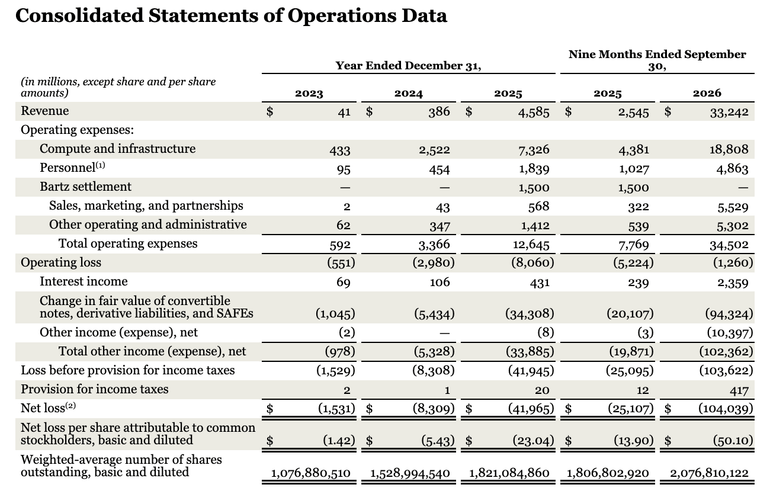
Anthropic is not yet profitable, and it lost a staggering $104 billion on paper in the first nine months of this year, after losing nearly $42 billion last year. However, its operating loss (revenues minus expenditures on its core AI business) appears to be shrinking over the last 12 months. Its revenue is also growing explosively: In the nine months of 2026, Anthropic brought in more than six times as much money as it made in all of 2025.
The prospectus notes that a large share of the net losses this year and last year — $102 billion this year and $34 billion last year — are only-on-paper accounting charges due to the increase in the market value of certain types of stakes owned by early investors in Anthropic, which have to be listed as liabilities under accounting rules even though they don't entail a real loss of money.
So is Anthropic a good investment? That's a complicated question that you probably need to ask your financial advisor, since so much of what you invest in depends on how your portfolio is constructed. We can say this: Anthropic is not yet profitable, but its revenue is growing fast and it's shrinking its operating losses over time.
How to buy Anthropic shares
Now that Anthropic has completed its IPO, its shares are available through any brokerage account that offers stocks. Its ticker symbol is NASDAQ: ANT. If you're looking for information about brokerage accounts, check out our roundup of the best brokerage accounts for stock trading.
Investing in Anthropic via funds
Another way to invest in Anthropic is indirectly, via exchange-traded funds or mutual funds.
Funds that claimed pre-IPO exposure to Anthropic
Despite the Anthropic board’s tight grip on pre-IPO shares, there are a few publicly traded funds that claim to own pre-IPO stakes in Anthropic.
By screening SEC filings, we found several funds available to retail investors that claim to have at least 2.5% of their assets in pre-IPO Anthropic shares.
Fund Name | Ticker | Anthropic Exposure (%) |
|---|---|---|
Destiny Tech100 Inc. | DXYZ | 14.40% |
Tema Photonics & Optical ETF | LAZR | 9.40% |
BlackRock Technology & Private Equity Term Trust | BTX | 8.61% |
BlackRock Science & Technology Trust | BST | 7.25% |
BlackRock Science & Technology Term Trust | BSTZ | 5.82% |
Source: SEC EDGAR database and fund websites. Data is current as of November 16, 2026, and is intended for informational purposes only. | ||
*DXYZ and LAZR are invested in special purpose vehicles that claim to have exposure to Anthropic shares. These claims feel suspicious to our team, especially in light of Anthropic’s warning about third-party pre-IPO investments (which explicitly says that pre-IPO investments in Anthropic through SPVs were not permitted). When reached, an Anthropic spokesperson declined to comment on these funds and could not verify their legitimacy. Use caution when deciding whether to invest in these funds.
Funds that will invest in Anthropic post-IPO
Earlier this year, several stock market indexes changed their rules ahead of the SpaceX IPO to "fast-track" the inclusion of mega-cap IPOs like SpaceX and Anthropic, by drastically shortening their customary waiting periods for companies with high market caps and daily trading volumes. Indexes that have made this change include the Nasdaq 100 and Nasdaq composite, as well as the Russell 500, Russell 1000 and Russell 3000.
All of these indexes added SpaceX within a few weeks of its IPO, and are likely to add Anthropic stock within a few weeks of its IPO as well. That means you might get some Anthropic exposure in Russell or Nasdaq index funds you own by the end of 2026.
Various total stock market funds and thematic AI and tech funds will also likely add Anthropic shares in the coming days. We will update this section as more information becomes available.
» Want to add these ETFs to your portfolio? Check out the best ETF platforms
Public companies that supply and own stakes in Anthropic
Yet another indirect way to get Anthropic exposure is by investing in its partners. There are several large, publicly traded tech companies that both act as suppliers to Anthropic and own multibillion-dollar equity stakes in the company. We’ve listed a few of Anthropic’s biggest shareholder-vendors below:
Alphabet (GOOG): Owns a stake in Anthropic worth more than $120 billion (more than 12% of Anthropic’s value) and is a major supplier of computer hardware and cloud computing services to the company.
Amazon (AMZN): Has invested at least $33 billion in Anthropic over the last few years (that stake may now be worth significantly more due to increases in Anthropic’s valuation). Also a major hardware and cloud services supplier to Anthropic.
Nvidia (NVDA): Invested $10 billion in Anthropic late last year (stake may be worth more now). Major hardware supplier to Anthropic and its partners.
Microsoft (MSFT): Invested $5 billion in Anthropic late last year (stake may be worth more now). Major supplier of cloud services to Anthropic.
Advanced Micro Devices (AMD): Invested $5 billion in Anthropic in late July. Major hardware supplier to Anthropic.
» Wondering if you're using the right platform? See our list of the best online brokers for stock trading
Be careful: The big AI IPOs haven’t gone great so far
Yup, it’s time for that part of the article where we harp on the risks of investing in big, flashy IPOs. But this time, we have a concrete, recent example.
SpaceX — which, in terms of valuation, largely consists of its subsidiary xAI, an Anthropic competitor — has had a rocky run since its June IPO, and has spent much of that time below its IPO price.
Maybe that’s peculiar to SpaceX. Or maybe it’ll just be the first of many trillion-dollar AI IPOs that fail to live up to their own hype. Would-be Anthropic shareholders should prepare themselves for that possibility, too.
Not an AI fan? Here's how to avoid Anthropic exposure after the IPO
Not everyone is excited about the rapid growth of the AI industry in recent years. NerdWallet's news team has written about how polls show that AI data center construction is deeply unpopular. The recent midterm elections delivered a slew of upset wins for candidates who took stances against AI data centers, including Texas governor-elect Gina Hinojosa, Ohio senator-elect Sherrod Brown and Ohio governor-elect Amy Acton.
If you're not a fan of the AI industry — or you want to avoid investing in Anthropic for some other reason, like fear of an AI bubble — then you might think that all you have to do is... y'know, not buy Anthropic shares. But it's actually not that simple. As we discussed above, Russell and Nasdaq funds, as well as total stock market funds, will likely buy Anthropic within days or weeks, meaning that many index fund investors will get some Anthropic exposure whether they like it or not.
There are a couple ways in which index fund investors can avoid exposure to Anthropic:
Stick to the S&P 500 and the Dow Jones Industrial Average (for now). S&P Dow Jones Indicies, which maintains both the S&P 500 and DJIA, has not changed its rules to expedite the inclusion of mega-cap tech IPOs. That means that Anthropic will have to go through a one-year waiting period before it joins the S&P 500, and would have to be manually added to the Dow by the committee that curates that index. The company likely will join both indexes eventually, but it won't happen as fast as its addition to the Nasdaq and Russell indexes. We have articles on Dow Jones ETFs and S&P 500 ETFs.
Look into direct indexing. This is a tax optimization strategy that involves buying fractional shares of all the stocks in an index fund (rather than the index fund itself). Direct indexing is usually a technique to make tax-loss harvesting easier, but you could also use it to exclude certain companies from an index (like Anthropic from the Nasdaq 100 or Russell 3000). Our best brokers for tax-loss harvesting roundup includes a list of brokers that offer direct indexing services with reasonable minimum balances.
A financial advisor's perspective
Jon Zetlmaier, a Washington-based certified financial planner, said in an email interview that Anthropic investors should keep their Anthropic allocation to between "1% to 5%" of their overall portfolio. But Anthropic's upcoming inclusion in Nasdaq and Russell large-cap indexes could make that tricky.
Zetlmaier also said that Anthropic needs to triple its revenues in the near future to warrant its trillion-dollar valuation. "If they are valued at $1T and have ~$35B trailing 4 quarter revenue, that will put them trading at 28x sales. Typically 20x is considered expensive. Most of the other $1T companies are trading at under 10x with only a few exceptions," Zetlmaier said.
"Expect a ride similar to SpaceX, which has swung up and down since its June debut," he added.
Article sources
- 1.CNN. Anthropic’s Wall Street debut marks a new chapter for AI. Accessed Nov 19, 2026.
- 2.NerdWallet. Buying Into AI: 39% of Americans Would Likely Invest at IPO, Survey Says. Accessed Nov 4, 2026.
- 3.Robinhood. IPO Access. Accessed Nov 16, 2026.
- 4.Fidelity. How to participate in the Anthropic IPO. Accessed Nov 16, 2026.
- 5.Charles Schwab. IPO & DPO stocks: Two types of new issue offerings. Accessed Nov 16, 2026.
- 6.SoFi. Anthropic IPO, explained. Accessed Nov 16, 2026.
- 7.E*TRADE. Anthropic IPO. Accessed Nov 16, 2026.
- 8.Securities and Exchange Commission. Anthropic, PBC (amended prospectus). Accessed Nov 19, 2026.
- 9.Anthropic. Unauthorized Anthropic stock sales and investment scams. Accessed Nov 19, 2026.
- 10.Nasdsaq. Nasdaq-100 Index® Methodology Changes. Accessed Nov 4, 2026.
- 11.LSEG. FTSE Russell introduces IPO Fast Entry enhancements for Russell US Indexes. Accessed Nov 4, 2026.
- 12.Bloomberg. Alphabet's Anthropic Stake Jumps to Around $124 Billion. Accessed Jul 31, 2026.
- 13.CNBC. Amazon to invest up to another $25 billion in Anthropic as part of AI infrastructure deal. Accessed Jul 31, 2026.
- 14.Microsoft. Microsoft, NVIDIA and Anthropic announce strategic partnerships. Accessed Jul 31, 2026.
- 15.Advanced Micro Devices. AMD and Anthropic Announce Strategic Partnership to Deploy Up to 2 Gigawatts of AMD Instinct MI450 Series GPUs. Accessed Jul 31, 2026.
- 16.S&P Dow Jones Indices. S&P Dow Jones Indices Consultation on Treatment of MegaCap Companies – Results. Accessed Nov 4, 2026.